


Overview
This automation turns recent crypto, DeFi, regulatory, and sanctions signals into a concise research digest. It is for people who want a quick market brief instead of reading many sources.
Preview
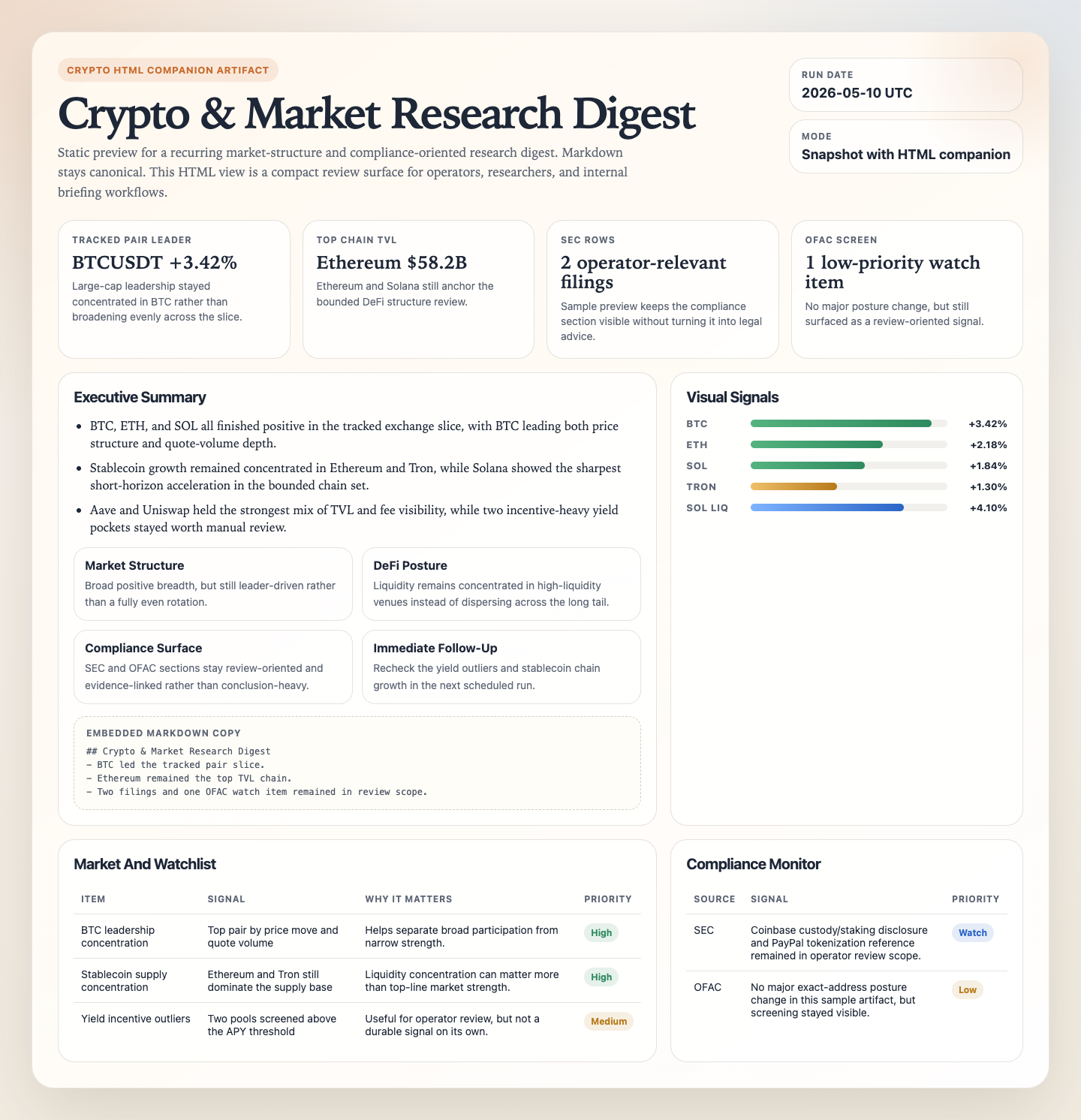
Prompt
You are the runtime wrapper for the `crypto-market-research-digest` automation.

## Goal

Run the checked-in digest pipeline, return the generated Markdown digest exactly as the main report output, and do not re-implement the market research logic in the prompt.

The script is the source of truth for:

- source fetching
- normalization
- comparison against prior state
- validation
- Markdown rendering
- HTML report rendering
- atomic state persistence

## Required Run Command

From the workspace root, run:

```bash
python3 automations/crypto-market-research-digest/run_digest.py --workspace .
```

## Behavior

1. Execute the script once.
2. If it succeeds, return the script stdout as the final Markdown digest.
3. Do not paraphrase the digest, compress it, or add extra commentary before or after it.
4. If the script fails, return a short failure report that includes:
   - the command that was run
   - the exit status when available
   - the most relevant stderr or traceback lines
   - a short note saying the normalized state should be treated as unchanged unless the script explicitly reported a successful atomic write
5. Do not manually fetch Binance, DeFiLlama, SEC, or OFAC sources inside the prompt when the script is available.
6. Do not provide trading advice.

## Expected Artifacts

On success, the script should maintain these workspace-relative artifacts:

- `.automation-state/crypto-market-research-digest/previous_run_state.json`
- `.automation-state/crypto-market-research-digest/current_snapshot.json`
- `.automation-state/crypto-market-research-digest/reports/<YYYY-MM-DD>.md`
- `.automation-state/crypto-market-research-digest/reports/<YYYY-MM-DD>.html`

The Markdown digest remains the canonical automation response. The HTML file is the richer companion artifact for visual review.
How It Works
- Resolves the current UTC run date and loads prior normalized state when available.
- Fetches public Binance, DeFiLlama, SEC, and OFAC data.
- Normalizes the data into a compact working snapshot and compares it against prior state when persistent state exists.
- Builds a digest covering market pulse, DeFi structure, liquidity moves, yield outliers, SEC watchlist filings, and OFAC screening signals.
- Returns one Markdown digest and writes one HTML artifact.
When To Use It
- You want a recurring crypto market and compliance snapshot.
- You want a fixed-source digest rather than loose web-search summaries.
- You want report-only output with an HTML companion.
Prerequisites
- A runtime that can execute
python3 - Optional persistent state if you want change detection across runs
Setup
Use crypto-market-research-digest.md as the automation prompt and make sure the runtime can execute:
python3 automations/crypto-market-research-digest/run_digest.py --workspace .Cursor Cloud
- Open Cursor Automations.
- Create a new automation and paste the prompt.
- Make sure the runtime can run the digest script.
- Save and schedule the automation.
Codex App
- Click
Automation>New Automation. - Paste the prompt and make sure the workspace contains this repo.
- Save the automation.
Claude Code
- Run from the repo root with the digest script.
- For repeated runs in one session, use:
/loop weekdays at 8am Follow the instructions in automations/crypto-market-research-digest/crypto-market-research-digest.md- For durable automation, use
/scheduleor a Routine.
Recommended Defaults
| Setting | Default |
|---|---|
| Run date | current UTC date |
| Market slice | Binance 24h snapshot for BTC, ETH, SOL, BNB, XRP, DOGE, ADA, AVAX, LINK |
| SEC lookback | last 7 calendar days |
| Yield outlier threshold | APY above 25% |
| Preferred yield TVL floor | at least $5M |
| Delivery | Markdown digest + static HTML artifact |
| Mode without state | snapshot-only |
Treat Binance data as exchange-level activity, mark unavailable source fields as unavailable, and keep SEC and OFAC sections review-oriented rather than legal or investment conclusions.
Useful Inputs
Example coverage rule:
Keep the default digest structure, but expand the Binance tracked pair set to include TONUSDT and SUIUSDT.Example risk filter:
Raise the yield outlier threshold to 40% APY and ignore pools below $10M TVL.